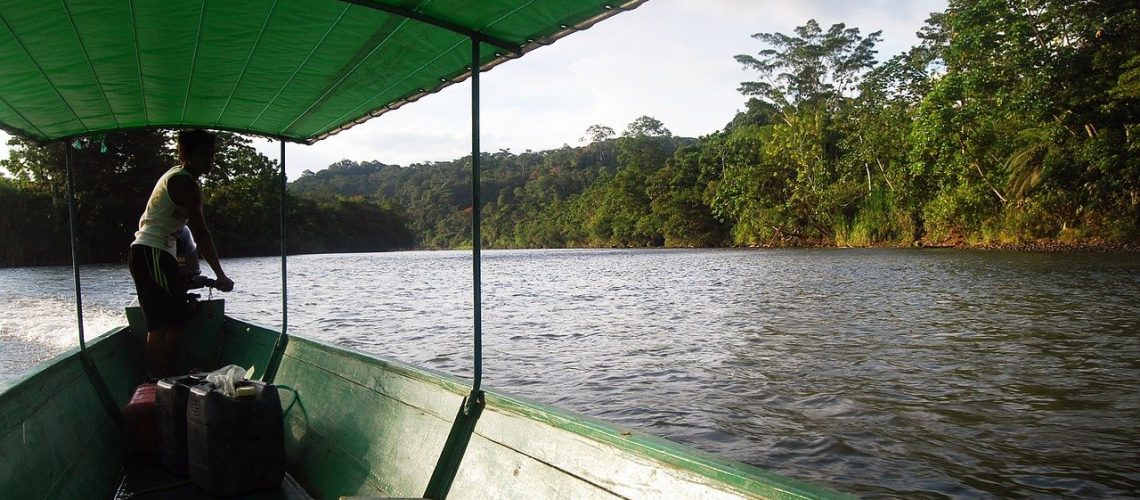
That part of South America generally known as Amazonia is a vast rainforest or jungle area straddling the Amazon river and which represents more than half of the remaining rainforest in the world and is the most biodiverse region on the planet.
Recent explorations have determined that the Amazon is the longest river in the world, but its predominance does not end there, for it is greater in volume than any other river, discharging considerably more water into the ocean than the next seven largest rivers combined. The sheer volume (20% of the world’s flowing water) causes the Amazon’s water to continue flowing for around 125 miles out to sea. It is said that in olden days, sailors could drink fresh water out of the sea days before they could ever see the South American continent.
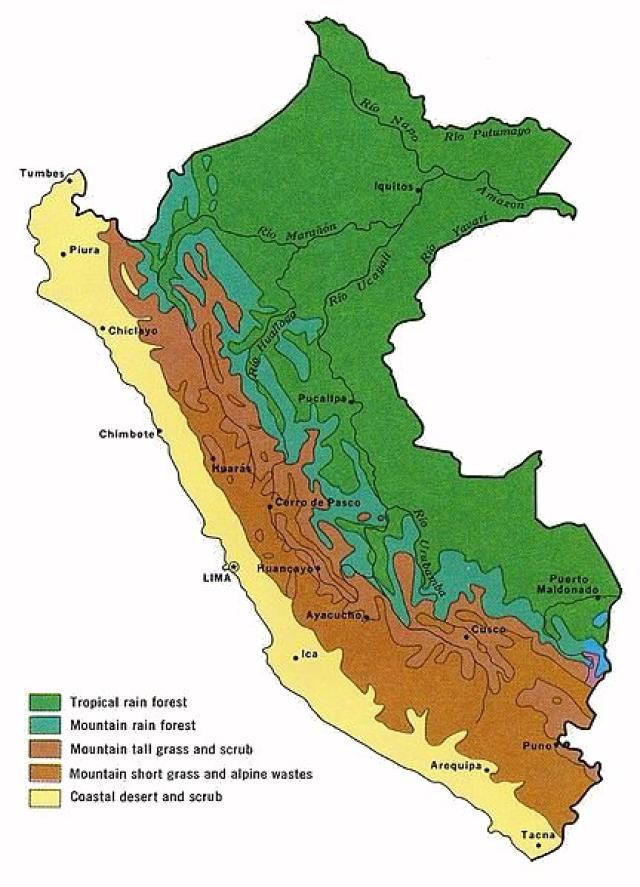
The river is massive and in Amazonia forms the largest river basin in the world containing by far the largest rainforest in the world, stretching from the Atlantic ocean in the east to the Andes mountain range in the west. The forest spans nine countries, one of which is Peru, where 60% of her land mass is rainforest, or selva, as the Peruvians call it. Of the remaining 40% of Peru, three quarters consists of the Andes mountains, leaving just 10% of the Country in which the bulk of the population reside, and that is arid desert.
The great biodiversity of Amazonia gives rise to an immense profusion of fauna and flora in the region. There are, for instance, some 2.5 million insect species and tens of thousands of plant species. One in five of all bird species on the planet live there and one in five of all fish species can be found in its rivers and streams. The list is endless, but the selva almost certainly contains thousands of species of flora and fauna that have yet to be discovered.
Rainforests perform essential ecological functions that support life. They provide food, medicines, fresh water from its rivers, and the rainfall to feed agricultural needs. However, Amazonia is especially important to the world for its role in taking carbon dioxide (a greenhouse gas) out of the air.
All trees and plants, as they grow, absorb carbon dioxide from the air and water from the ground, and, through a process known as photosynthesis, give off oxygen. This is of tremendous importance, because carbon dioxide is a primary driver of global warming, and oxygen is necessary to enable humans and other animals to breathe. It is estimated that trees and plants in the Amazonia region actually give off as much as 20% of the world’s oxygen. There is an adage which says that if the health of the Amazon is good, then so is that of the planet. However, whilst the trees are able to store this carbon, when they are cut down the carbon dioxide is released. Thus, the selva is, in effect, a giant carbon storage facility and deforestation could have catastrophic consequences for the world and it is vital, therefore, that it be curtailed.
Most of the deforestation which is occurring is caused by human settlement of the land and by logging, but another significant cause is for the purpose of mineral extraction. Peru, in particular, is very rich in a variety of minerals, including oil. Much of this logging and extraction, however, is carried on illegally and is, therefore, unregulated, which exacerbates the problem. Generally the deforestation in Peru is less than in some of the other Amazonian countries, notably Brazil.
It is not only wildlife that inhabit the rainforest, for it is also the ancestral home of a million Indians, which divides into around 400 tribes, each with its own language, culture and territory. Many of these tribes have had very little contact with the outside world; some have had no contact at all. Whilst I was in Peru a few years ago, a new tribe was discovered which hitherto it had not been known existed.
Peru has a growing tourist industry, coronavirus permitting, and it can be recommended for a holiday, but if you go there do not just visit Machu Picchu (wonderful place that it is) and think that you have seen Peru. Do visit the jungle, it is a fascinating area and you may well find that it was the highlight of your holiday.
DB